Generative AI vs Agentic AI
Generative AI vs Agentic AI: What’s the Difference and Which Career Pays More in 2026?
The Artificial Intelligence industry is evolving faster than ever. In 2026, two of the most talked-about domains are:
- Generative AI (GenAI)
- Agentic AI (AI Agents / Autonomous AI Systems)
Both are powerful, both are in demand, and both are shaping the future of software development and automation. However, they are not the same, and they also differ in salary growth, career scope, and job roles.
In this detailed guide, we will compare Generative AI vs Agentic AI, explore their differences, and analyze which career pays more in 2026.
🚀 What is Generative AI?
Generative AI refers to AI systems that can create new content such as:
- Text (blogs, emails, reports)
- Images (AI art, designs)
- Code (programming assistance)
- Audio & video
🔹 Popular Generative AI Tools:
- ChatGPT (OpenAI)
- Midjourney
- Stable Diffusion
- Claude AI
- Gemini (Google)
🔹 How it Works:
Generative AI uses Large Language Models (LLMs) trained on massive datasets to generate human-like output based on prompts.
👉 It is primarily reactive AI (responds to user input).
🤖 What is Agentic AI?
Agentic AI is the next evolution of AI systems where AI can:
- Plan tasks
- Take actions
- Use tools
- Make decisions
- Work independently without constant human input
🔹 Popular Frameworks:
- LangChain
- CrewAI
- AutoGen (Microsoft)
- OpenAI Agents SDK
🔹 How it Works:
Agentic AI uses multiple AI agents working together to complete complex workflows.
👉 It is autonomous AI (goal-driven AI systems).
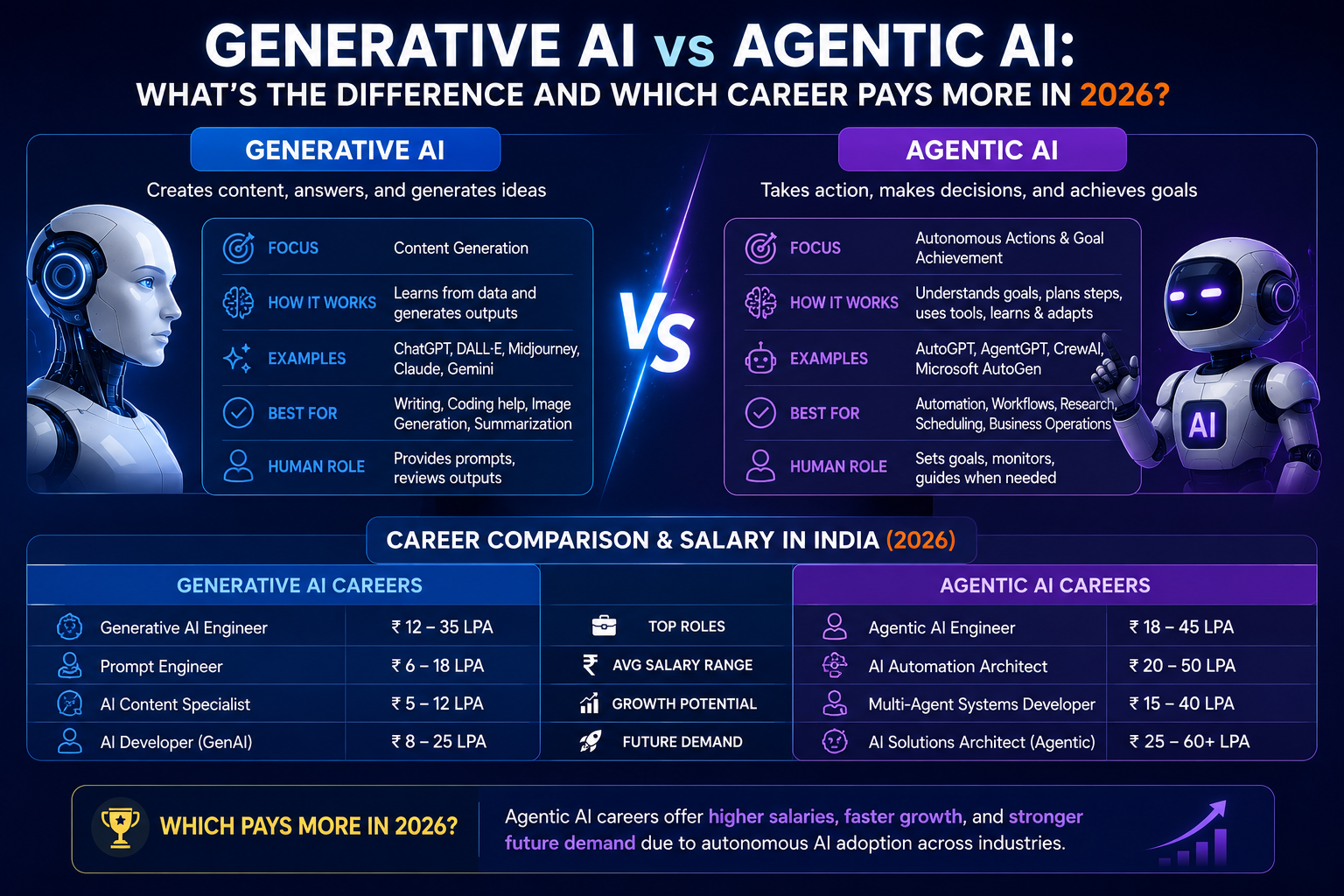
🆚 Generative AI vs Agentic AI (Key Differences)
| Feature | Generative AI | Agentic AI |
|---|---|---|
| Core Function | Creates content | Executes tasks autonomously |
| Behavior | Reactive | Proactive |
| Decision Making | No independent decisions | Makes decisions |
| Workflow | Single-step output | Multi-step workflow |
| Tools Used | GPT, Midjourney, Claude | LangChain, CrewAI, AutoGen |
| Human Dependency | High | Low |
| Complexity Level | Medium | High |
| Example | Write a blog | Research + write + publish blog automatically |
📊 Visual Comparison: AI Evolution Trend
🧠 How Generative AI Works (Simple Explanation)
Generative AI works in three steps:
- User gives a prompt
- Model processes input using trained parameters
- Output is generated based on probability patterns
💡 Example:
Prompt: “Write a marketing email”
Output: AI generates structured email content
👉 It does NOT plan actions or execute tasks.
🧠 How Agentic AI Works
Agentic AI works differently:
- User gives a goal
- AI breaks it into tasks
- Multiple agents execute tasks
- System evaluates results
- Final output is delivered
💡 Example:
Goal: “Launch a marketing campaign”
Agent workflow:
- Research agent collects data
- Copywriting agent writes ads
- SEO agent optimizes content
- Publishing agent schedules posts
👉 Entire workflow is automated.
💼 Job Roles in Generative AI vs Agentic AI
| Generative AI Roles | Agentic AI Roles |
|---|---|
| Prompt Engineer | AI Agent Developer |
| AI Content Developer | AI Automation Engineer |
| LLM Engineer | Agentic AI Engineer |
| Machine Learning Engineer | AI Systems Architect |
| AI Application Developer | Multi-Agent System Engineer |
💰 Salary Comparison in India (2026)
Both fields are high-paying, but Agentic AI is slightly ahead due to complexity and demand.
📊 Salary Overview
| Experience Level | Generative AI Salary | Agentic AI Salary |
|---|---|---|
| Fresher (0–1 yr) | ₹5 – ₹10 LPA | ₹6 – ₹12 LPA |
| Junior (1–3 yr) | ₹8 – ₹18 LPA | ₹10 – ₹22 LPA |
| Mid-Level (3–6 yr) | ₹18 – ₹35 LPA | ₹22 – ₹45 LPA |
| Senior (6–10 yr) | ₹35 – ₹60 LPA | ₹40 – ₹70 LPA |
| Expert (10+ yr) | ₹60 LPA – ₹1 Cr+ | ₹70 LPA – ₹1.2 Cr+ |
📈 Salary Growth Visualization
📊 Why Agentic AI Pays More in 2026
Agentic AI engineers are paid more because:
🔹 1. Higher Complexity
Building autonomous systems is harder than generating content.
🔹 2. Business Impact
Agentic AI can replace entire workflows.
🔹 3. Talent Shortage
Very few engineers understand multi-agent systems.
🔹 4. Enterprise Adoption
Companies are moving from tools → autonomous AI systems.
🧩 Skills Required
🔹 Generative AI Skills
- Prompt Engineering
- LLM APIs (OpenAI, Claude)
- RAG systems
- Vector databases
- Python programming
🔹 Agentic AI Skills
- LangChain
- CrewAI
- AutoGen
- Multi-agent systems
- AI workflow automation
- Tool calling systems
🏆 Career Growth Path
Step 1:
Python + AI basics
Step 2:
Generative AI development
Step 3:
LLM applications + RAG systems
Step 4:
Agentic AI frameworks
Step 5:
AI Architect / AI Systems Engineer
🏫 Learning from Training Institutes
Institutes like IPEC Solutions Pvt. Ltd. and similar AI training centers offer:
- Structured AI & ML courses
- Hands-on projects
- Generative AI + Agentic AI training
- Placement support
- Internship opportunities
👉 This helps students become industry-ready faster.
🔮 Future Scope (2026–2030)
Generative AI Future:
- Content automation
- AI assistants
- Marketing automation tools
Agentic AI Future:
- Fully autonomous companies
- AI employees replacing manual workflows
- Smart enterprise systems
👉 Agentic AI is expected to dominate the next phase of AI evolution.
🧾 Final Conclusion
Both Generative AI and Agentic AI are powerful career paths, but:
- Generative AI = foundation of AI content generation
- Agentic AI = future of autonomous AI systems
💡 Final Answer:
👉 In 2026, Agentic AI pays more than Generative AI due to higher complexity and enterprise demand.
Post categories
- AI Generalist
- AI Accelerator (Data Scientist )
- AI & ML
- AGENTIC AI
- Python Developer
Recent Posts
Best AI and ML certification for career growth

Machine Learning course for students
how to become data scientist India 2026
data science vs data analytics 2026
data scientist salary Bangalore 2026