
Data Science Training in Bangalore
The Data Science Training in Bangalore by IPEC Solutions is designed for students and working professionals who want to start or switch to a high-growth data science career.
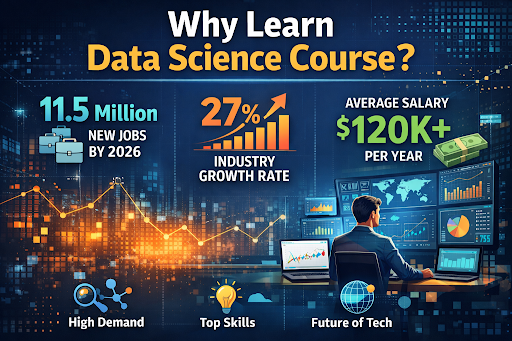
Why Learn Data Science Course?
Data Science is leading the technological revolution, transforming the way businesses make decisions by turning raw data into actionable insights. Today, companies generate massive amounts of data, with an estimated 2.5 quintillion bytes created every day, making data management and analysis essential for growth. This explosive growth in data is driving an unprecedented demand for skilled data professionals.Top global companies such as Amazon, Google, Microsoft, and Netflix heavily rely on data science to optimize operations, enhance user experiences, and predict market trends. For instance, Amazon uses machine learning algorithms to power product recommendations, while Netflix leverages data to personalize content suggestions. Similarly, financial firms employ predictive analytics to detect fraud and minimize risk, and healthcare organizations analyze patient data to improve outcomes, driving strong demand for data science training in Bangalore.
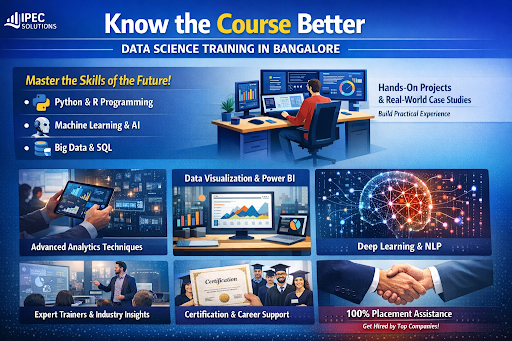
Course Highlights – Perfect for Students & Career Changers
Beginner-friendly Data Science curriculum
Ideal for students and working professionals
Step-by-step training from basics to advanced
Python programming taught from scratch
Easy explanation of statistics and data concepts
Hands-on practice with real-world datasets
Training on data analysis and machine learning tools
Live projects to build practical experience
Resume building and interview preparation support
Career guidance for job switchers
Certification from IPEC Solutions
Placement assistance with industry connections
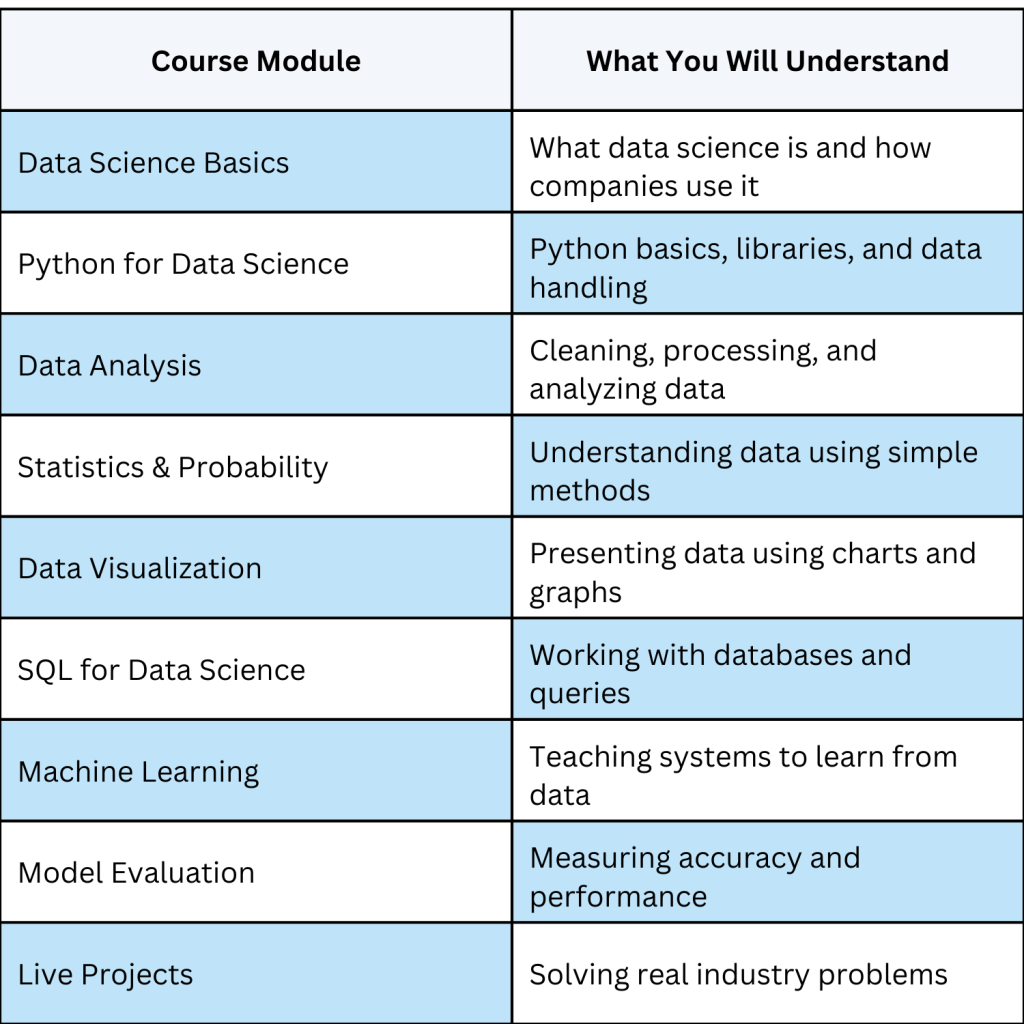
What You Will Learn in This Data Science Course
| Course Name | Batch Start Date | Weekday Timing | Weekend Timing |
|---|---|---|---|
| Data Science & AI Accelerator (Data Scientist) | 13/04/2026 | 10 am - 11 am (Mon-Fri) | 10 am - 1 pm (Sat-Sun) |
| AI-ML with Python (Intelligent Automation Engineer) | 15/04/2026 | 11 am - 12 pm (Mon-Fri) | 2 pm - 5 pm (Sat-Sun) |
| Excel Xpert (Microsoft Excel Mastery Program) | 11/05/2026 | 2 pm - 3 pm (Mon-Fri) | 2 pm - 5 pm (Sat-Sun) |
| Ai-Powered Data Analytics (Excel, SQL, POWER-BI & AI) | 15/04/2026 | 2 pm - 3 pm (Mon-Fri) | 10 am - 1 pm (Sat-Sun) |
| Data Xcelerator 3.0 (Analytics to Dashboard Mastery) | 10/05/2026 | 3 pm - 4 pm (Mon-Fri) | 10 am - 1 pm (Sat-Sun) |
| Advanced Certified Professional in AI-Data Science | 15/04/2026 | 3 pm - 4 pm (Mon-Fri) | 2 pm - 5 pm (Sat-Sun) |
| Python Developer Program (PyPro -360) | 14/05/2026 | 11 am - 12 pm (Mon-Fri) | 2 pm - 5 pm (Sat-Sun) |
| Gen AI Mastery (GEN AI Mastery for Non-Coders) | 12/05/2026 | 2 pm - 3 pm (Mon-Fri) | 10 am - 1 pm (Sat-Sun) |
| Business Data Analytics | 15/05/2026 | 3 pm - 4 pm (Mon-Fri) | 2 pm - 5 pm (Sat-Sun) |
| AI in Medical | 11/05/2026 | 10 am - 11 am (Mon-Fri) | 10 am - 1 pm (Sat-Sun) |
| DevOps, AWS, Linux, Networking (4 in 1) | 15/04/2026 | 10 am - 11 am (Mon-Fri) | 10 am - 1 pm (Sat-Sun) |
| Financial Data Analyst | 12/06/2026 | 11 am - 12 pm (Mon-Fri) | 2 pm - 5 pm (Sat-Sun) |
| Retail Data Analyst | 10/06/2026 | 2 pm - 3 pm (Mon-Fri) | 10 am - 1 pm (Sat-Sun) |
| Stock Market Data Analyst | 14/06/2026 | 3 pm - 4 pm (Mon-Fri) | 2 pm - 5 pm (Sat-Sun) |
| Healthcare Data Analyst | 13/06/2026 | 2 pm - 3 pm (Mon-Fri) | 10 am - 1 pm (Sat-Sun) |
| Python Mastery: Beginner to Expert | 12/04/2026 | 10 am - 11 am (Mon-Fri) | 10 am - 1 pm (Sat-Sun) |
| C Developer | 10/07/2026 | 11 am - 12 pm (Mon-Fri) | 2 pm - 5 pm (Sat-Sun) |
| Data Structures Using JAVA | 15/05/2026 | 11 am - 12 pm (Mon-Fri) | 10 am - 1 pm (Sat-Sun) |
| Advanced JAVA | 13/05/2026 | 2 pm - 3 pm (Mon-Fri) | 2 pm - 5 pm (Sat-Sun) |
| C++ Developer | 11/07/2026 | 10 am - 11 am (Mon-Fri) | 10 am - 1 pm (Sat-Sun) |
| C++ with Data Structures | 14/07/2026 | 2 pm - 3 pm (Mon-Fri) | 2 pm - 5 pm (Sat-Sun) |
| Core JAVA | 15/05/2026 | 10 am - 11 am (Mon-Fri) | 2 pm - 5 pm (Sat-Sun) |
| Python Advanced | 13/04/2026 | 2 pm - 3 pm (Mon-Fri) | 10 am - 1 pm (Sat-Sun) |
| Data Analytics with Python | 12/05/2026 | 11 am - 12 pm (Mon-Fri) | 2 pm - 5 pm (Sat-Sun) |
| JAVA with JDBC | 11/05/2026 | 2 pm - 3 pm (Mon-Fri) | 10 am - 1 pm (Sat-Sun) |
Data Science Training Syllabus
DATA SCIENCE FOUNDATION
MODULE 1: DATA SCIENCE ESSENTIALS
• Introduction to Data Science
• Evolution of Data Science
• Big Data Vs Data Science
• Data Science Terminologies
• Data Science vs AI/Machine Learning
• Data Science vs Analytics
MODULE 2: DATA SCIENCE DEMO
• Business Requirement: Use Case
• Data Preparation
• Machine learning Model building
• Prediction with ML model
• Delivering Business Value.
MODULE 3: ANALYTICS CLASSIFICATION
• Types of Analytics
• Descriptive Analytics
• Diagnostic Analytics
• Predictive Analytics
• Prescriptive Analytics
• EDA and insight gathering demo in Tableau
MODULE 4: DATA SCIENCE AND RELATED FIELDS
• Introduction to AI
• Introduction to Computer Vision
• Introduction to Natural Language Processing
• Introduction to Reinforcement Learning
• Introduction to GAN
• Introduction to Generative Passive Models
MODULE 5: DATA SCIENCE ROLES & WORKFLOW
• Data Science Project workflow
• Roles: Data Engineer, Data Scientist, ML Engineer and MLOps Engineer
• Data Science Project stages.
MODULE 6: MACHINE LEARNING INTRODUCTION
• What Is ML? ML Vs AI
• ML Workflow, Popular ML Algorithms
• Clustering, Classification And Regression
• Supervised Vs Unsupervised
MODULE 7: DATA SCIENCE INDUSTRY APPLICATIONS
• Data Science in Finance and Banking
• Data Science in Retail
• Data Science in Health Care
• Data Science in Logistics and Supply Chain
• Data Science in Technology Industry
• Data Science in Manufacturing
• Data Science in Agriculture
PYTHON FOUNDATION
MODULE 1: PYTHON BASICS
• Introduction of python
• Installation of Python and IDE
• Python Variables
• Python basic data types
• Number & Booleans, strings
• Arithmetic Operators
• Comparison Operators
• Assignment Operators
MODULE 2: PYTHON CONTROL STATEMENTS
• IF Conditional statement
• IF-ELSE
• NESTED IF
• Python Loops basics
• WHILE Statement
• FOR statements
• BREAK and CONTINUE statements
MODULE 3: PYTHON DATA STRUCTURES
• Basic data structure in python
• Basics of List
• List: Object, methods
• Tuple: Object, methods
• Sets: Object, methods
• Dictionary: Object, methods
MODULE 4: PYTHON FUNCTIONS
• Functions basics
• Function Parameter passing
• Lambda functions
• Map, reduce, filter functions
STATISTICS ESSENTIALS
MODULE 1: OVERVIEW OF STATISTICS
• Introduction to Statistics
• Descriptive And Inferential Statistics
• Basic Terms Of Statistics
• Types Of Data
MODULE 2: HARNESSING DATA
• Random Sampling
• Sampling With Replacement And Without Replacement
• Cochran’s Minimum Sample Size
• Types of Sampling
• Simple Random Sampling
• Stratified Random Sampling
• Cluster Random Sampling
• Systematic Random Sampling
• Multi stage Sampling
• Sampling Error
• Methods Of Collecting Data
MODULE 3: EXPLORATORY DATA ANALYSIS
• Exploratory Data Analysis Introduction
• Measures Of Central Tendencies: Mean,Median And Mode
• Measures Of Central Tendencies: Range, Variance And Standard Deviation
• Data Distribution Plot: Histogram
• Normal Distribution & Properties
• Z Value / Standard Value
• Empirical Rule and Outliers
• Central Limit Theorem
• Normality Testing
• Skewness & Kurtosis
• Measures Of Distance: Euclidean, Manhattan And Minkowski Distance
• Covariance & Correlation
MODULE 4: HYPOTHESIS TESTING
• Hypothesis Testing Introduction
• P- Value, Critical Region
• Types of Hypothesis Testing
• Hypothesis Testing Errors : Type I And Type II
• Two Sample Independent T-test
• Two Sample Relation T-test
• One Way Anova Test
• Application of Hypothesis testing
MACHINE LEARNING ASSOCIATE
MODULE 1: MACHINE LEARNING INTRODUCTION
• What Is ML? ML Vs AI
• Clustering, Classification And Regression
• Supervised Vs Unsupervised
MODULE 2: PYTHON NUMPY PACKAGE
• Introduction to Numpy Package
• Array as Data Structure
• Core Numpy functions
• Matrix Operations, Broadcasting in Arrays
MODULE 3: PYTHON PANDAS PACKAGE
• Introduction to Pandas package
• Series in Pandas
• Data Frame in Pandas
• File Reading in Pandas
• Data munging with Pandas
MODULE 4: VISUALIZATION WITH PYTHON – Matplotlib
• Visualization Packages (Matplotlib)
• Components Of A Plot, Sub-Plots
• Basic Plots: Line, Bar, Pie, Scatter
MODULE 5: PYTHON VISUALIZATION PACKAGE – SEABORN
• Seaborn: Basic Plot
• Advanced Python Data Visualizations
MODULE 6: ML ALGO: LINEAR REGRESSSION
• Introduction to Linear Regression
• How it works: Regression and Best Fit Line
• Modeling and Evaluation in Python
MODULE 7: ML ALGO: LOGISTIC REGRESSION
• Introduction to Logistic Regression
• How it works: Classification & Sigmoid Curve
• Modeling and Evaluation in Python
MODULE 8: ML ALGO: K MEANS CLUSTERING
• Understanding Clustering (Unsupervised)
• K Means Algorithm
• How it works : K Means theory
• Modeling in Python
MODULE 9: ML ALGO: KNN
• Introduction to KNN
• How It Works: Nearest Neighbor Concept
• Modeling and Evaluation in Python
MACHINE LEARNING EXPERT
MODULE 1: FEATURE ENGINEERING
• Introduction to Feature Engineering
• Feature Engineering Techniques: Encoding, Scaling, Data Transformation
• Handling Missing values, handling outliers
• Creation of Pipeline
• Use case for feature engineering
MODULE 2: ML ALGO: SUPPORT VECTOR MACHINE (SVM)
• Introduction to SVM
• How It Works: SVM Concept, Kernel Trick
• Modeling and Evaluation of SVM in Python
MODULE 3: PRINCIPAL COMPONENT ANALYSIS (PCA)
• Building Blocks Of PCA
• How it works: Finding Principal Components
• Modeling PCA in Python
MODULE 4: ML ALGO: DECISION TREE
• Introduction to Decision Tree & Random Forest
• How it works
• Modeling and Evaluation in Python
MODULE 5: ENSEMBLE TECHNIQUES – BAGGING
• Introduction to Ensemble technique
• Bagging and How it works
• Modeling and Evaluation in Python
MODULE 6: ML ALGO: NAÏVE BAYES
• Introduction to Naive Bayes
• How it works: Bayes’ Theorem
• Naive Bayes For Text Classification
• Modeling and Evaluation in Python
MODULE 7: GRADIENT BOOSTING, XGBOOST
• Introduction to Boosting and XGBoost
• How it works?
• Modeling and Evaluation of in Python
ADVANCED DATA SCIENCE
MODULE 1: TIME SERIES FORECASTING – ARIMA
• What is Time Series?
• Trend, Seasonality, cyclical and random
• Stationarity of Time Series
• Autoregressive Model (AR)
• Moving Average Model (MA)
• ARIMA Model
• Autocorrelation and AIC
• Time Series Analysis in Python
MODULE 2: SENTIMENT ANALYSIS
• Introduction to Sentiment Analysis
• NLTK Package
• Case study: Sentiment Analysis on Movie Reviews
MODULE 3: REGULAR EXPRESSIONS WITH PYTHON
• Regex Introduction
• Regex codes
• Text extraction with Python Regex
MODULE 4: ML MODEL DEPLOYMENT WITH FLASK
• Introduction to Flask
• URL and App routing
• Flask application – ML Model deployment
MODULE 5: ADVANCED DATA ANALYSIS WITH MS EXCEL
• MS Excel core Functions
• Advanced Functions (VLOOKUP, INDIRECT..)
• Linear Regression with EXCEL
• Data Table
• Goal Seek Analysis
• Pivot Table
• Solving Data Equation with EXCEL
MODULE 6: AWS CLOUD FOR DATA SCIENCE
• Introduction of cloud
• Difference between GCC, Azure, AWS
• AWS Service ( EC2 instance)
MODULE 7: AZURE FOR DATA SCIENCE
• Introduction to AZURE ML studio
• Data Pipeline
• ML modeling with Azure
MODULE 8: INTRODUCTION TO DEEP LEARNING
• Introduction to Artificial Neural Network, Architecture
• Artificial Neural Network in Python
• Introduction to Convolutional Neural Network, Architecture
• Convolutional Neural Network in Python
DATABASE: SQL AND MONGODB
MODULE 1: DATABASE INTRODUCTION
• DATABASE Overview
• Key concepts of database management
• Relational Database Management System
• CRUD operations
MODULE 2: SQL BASICS
• Introduction to Databases
• Introduction to SQL
• SQL Commands
• MY SQL workbench installation
MODULE 3: DATA TYPES AND CONSTRAINTS
• Numeric, Character, date time data type
• Primary key, Foreign key, Not null
• Unique, Check, default, Auto increment
MODULE 4: DATABASES AND TABLES (MySQL)
• Create database
• Delete database
• Show and use databases
• Create table, Rename table
• Delete table, Delete table records
• Create new table from existing data types
• Insert into, Update records
• Alter table
MODULE 5: SQL JOINS
• Inner Join, Outer Join
• Left Join, Right Join
• Self Join, Cross join
• Windows function: Over, Partition, Rank
MODULE 6: SQL COMMANDS AND CLAUSES
• Select, Select distinct
• Aliases, Where clause
• Relational operators, Logical
• Between, Order by, In
• Like, Limit, null/not null, group by
• Having, Sub queries
MODULE 7 : DOCUMENT DB/NO-SQL DB
• Introduction of Document DB
• Document DB vs SQL DB
• Popular Document DBs
• MongoDB basics
• Data format and Key methods
GIT
MODULE 1: GIT INTRODUCTION
• Purpose of Version Control
• Popular Version control tools
• Git Distribution Version Control
• Terminologies
• Git Workflow
• Git Architecture
MODULE 2: GIT REPOSITORY and GitHub
• Git Repo Introduction
• Create New Repo with Init command
• Git Essentials: Copy & User Setup
• Mastering Git and GitHub
MODULE 3: COMMITS, PULL, FETCH AND PUSH
• Code Commits
• Pull, Fetch and Conflicts resolution
• Pushing to Remote Repo
MODULE 4: TAGGING, BRANCHING AND MERGING
• Organize code with branches
• Checkout branch
• Merge branches
• Editing Commits
• Commit command Amend flag
• Git reset and revert
MODULE 5: GIT WITH GITHUB AND BITBUCKET
• Creating GitHub Account
• Local and Remote Repo
• Collaborating with other developers
BIG DATA FOUNDATION
MODULE 1: BIG DATA INTRODUCTION
• Big Data Overview
• Five Vs of Big Data
• What is Big Data and Hadoop
• Introduction to Hadoop
• Components of Hadoop Ecosystem
• Big Data Analytics Introduction
MODULE 2 : HDFS AND MAP REDUCE
• HDFS – Big Data Storage
• Distributed Processing with Map Reduce
• Mapping and reducing stages concepts
• Key Terms: Output Format, Partitioners,
• Combiners, Shuffle, and Sort
MODULE 3: PYSPARK FOUNDATION
• PySpark Introduction
• Spark Configuration
• Resilient distributed datasets (RDD)
• Working with RDDs in PySpark
• Aggregating Data with Pair RDDs
MODULE 4: SPARK SQL and HADOOP HIVE
• Introducing Spark SQL
• Spark SQL vs Hadoop Hive
BI ANALYST
MODULE 1: TABLEAU FUNDAMENTALS
• Introduction to Business Intelligence & Introduction to Tableau
• Interface Tour, Data visualization: Pie chart, Column chart, Bar chart.
• Bar chart, Tree Map, Line Chart
• Area chart, Combination Charts, Map
• Dashboards creation, Quick Filters
• Create Table Calculations
• Create Calculated Fields
• Create Custom Hierarchies
MODULE 2: POWER-BI BASICS
• Power BI Introduction
• Basics Visualizations
• Dashboard Creation
• Basic Data Cleaning
• Basic DAX FUNCTION
MODULE 3 : DATA TRANSFORMATION TECHNIQUES
• Exploring Query Editor
• Data Cleansing and Manipulation:
• Creating Our Initial Project File
• Connecting to Our Data Source
• Editing Rows
• Changing Data Types
• Replacing Values
MODULE 4: CONNECTING TO VARIOUS DATA SOURCES
• Connecting to a CSV File
• Connecting to a Webpage
• Extracting Characters
• Splitting and Merging Columns
• Creating Conditional Columns
• Creating Columns from Examples
• Create Data Model
Our Certification
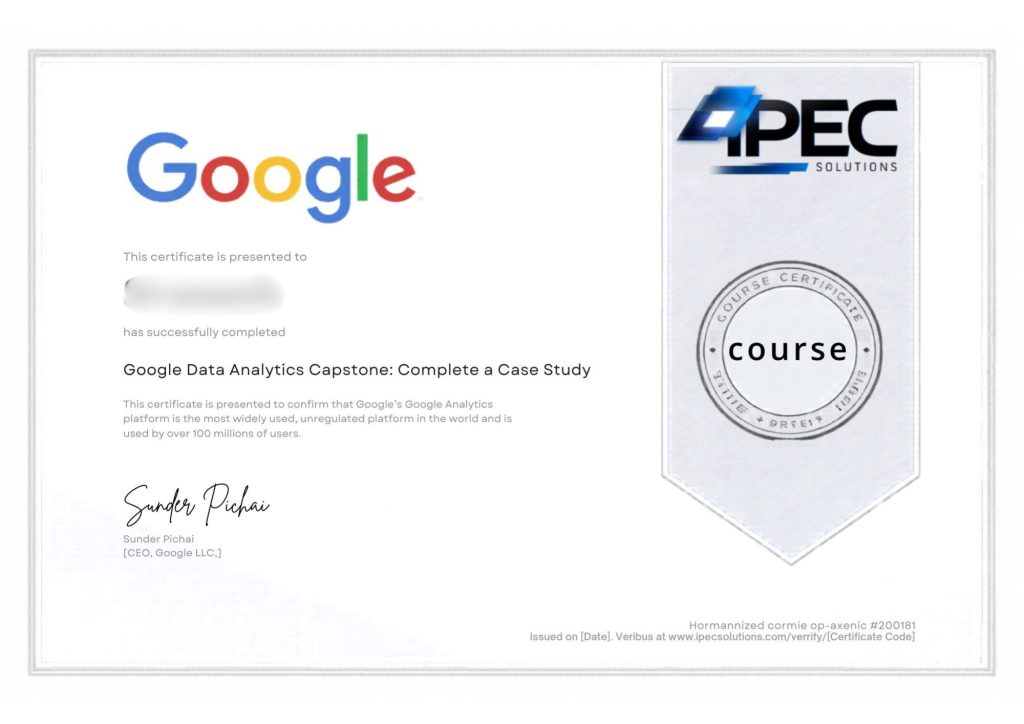
google certification
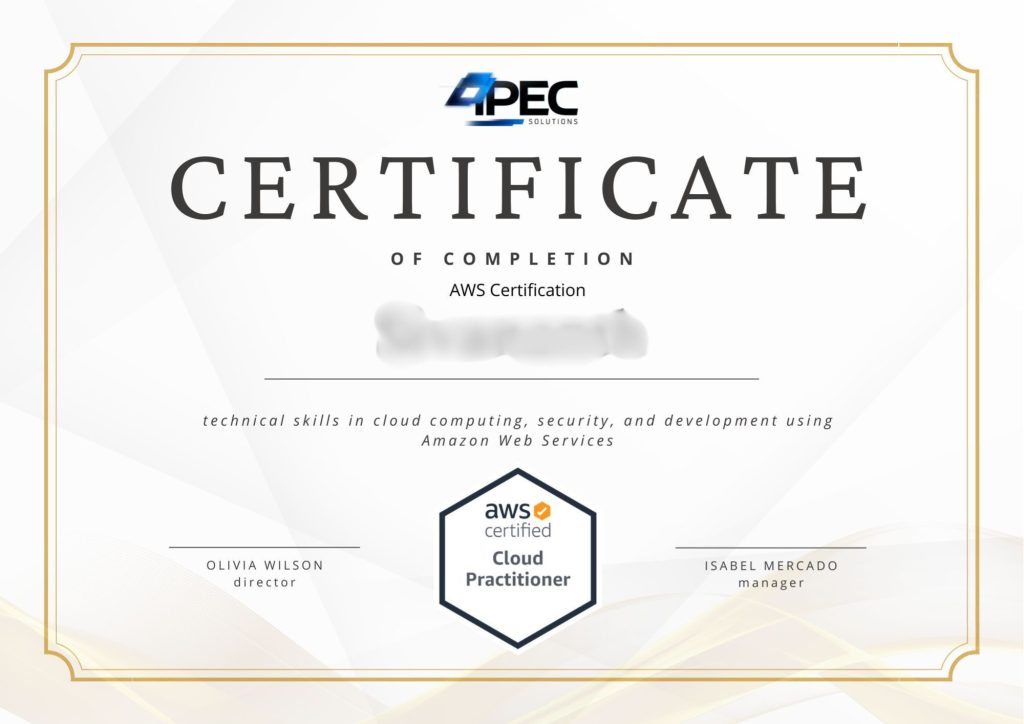
AWS certification

Microsoft certification
High-Impact Certifications That Strengthen Data Science Job Opportunities
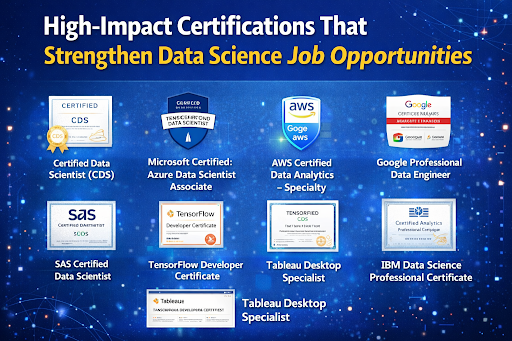
- Certified Data Scientist (CDS)
- Microsoft Certified: Azure Data Scientist Associate
- AWS Certified Data Analytics – Specialty
- Google Professional Data Engineer
- SAS Certified Data Scientist
- Cloudera Certified Associate (CCA) Data Analyst
- TensorFlow Developer Certificate
- Tableau Desktop Specialist
- IBM Data Science Professional Certificate
- Certified Analytics Professional (CAP)
Become an expert in your field with our Offline/ online courses.
Unlock your full potential with our expert-led Offline / online courses. skills and career growth through data science training in Bangalore.
What Our Students Say
Student Experiences: In Their Own Words
Hear from our successful students who have transformed their careers with iPEC’s hands-on training. From mastering AI and automation to securing top industry roles, our graduates share how iPEC’s expert mentorship, real-world projects, and career-focused learning helped them achieve their dreams.